The question of continuity between Iron Age religious practices in Gaul/Germany or Britain and Roman religion and cult centers is really complex. Historians and archaeologists have been investigating this and are interested in answering this question for decades. Romans described Gaul (Latin: Gallia) as a region of Western Europe which included present-day countries like France, Belgium, Luxembourg, and parts of Switzerland, the Netherlands, Germany, and Northern Italy. It covered an area of 494,000 km2 (Aaron, 1832). It is interesting to explore which practices of the Iron Age religions were adopted by Roman religion, and which gods were assimilated between these two types of religions. We will first look at the religious practices of the Iron Age and then explore its influence and adaptation in relation to Roman religion and cult centers.
To take on this question we need to first take a closer look at the state of religion in the iron age. We can do that by looking at the religious practices that were present at that time. But there is one important thing to note here that Iron Age religion should not be studied in terms of a “world religion” but it is a collection of stories and beliefs of magic, nature spirits, and local divinities (Ross, 1986). The variation in the expression of religious rituals and behaviors can be studied and understood only if we look at it from a different perspective. It is evident when we study the texts from this era that religious rituals played a major role in shaping the lives of people in that region. They did not see religion as a separate institution as we do, rather they have a completely different and integrated view of religion with their daily life activities (Dillon & Chadwick, 1967).
To explore the religion of the iron age in Britain and Germany one has to look at the classical texts to see the mentions of religious stories and rituals. Because the ancient Romans wrote about the customs of the non-writing societies they encountered, literature has contributed to our understanding of Iron Age European religion. It is also important to note here that these accounts of prehistoric or Iron Age practices and rituals are taken from only archeological evidence or from the texts of Romans who described people of these areas at that time. According to Roman accounts, the inhabitants of ancient Gaul and Britain practised polytheism which means that they believe in multiple gods and deities. Through the writings we also found that those people believed in the afterlife. The Druids had a significant role in the religion and were portrayed by numerous ancient writers as a group of mages, prophets, and philosophers. They talk about how sacred forests, in particular, were important to Iron Age European religion. Additionally, some writers assert the existence of human sacrifice (Jody, 2011).
Cicero gave us an explanation of the insular druidic theory in his 69 BC work Pro Fonteio (Benvenuti 1991:38f). During his period, he stated, the Gauls offered human sacrifices on altars and in temples as a form of honouring their gods (Cicero: Pro Fonteio 39 from Perseus, 2009). Following the military expedition in Gaul in 58–51 BC led by Julius Caesar, a new approach to studying the Celts became possible. Caesar included several chapters on the Iron Age Britons in his chronicles of these campaigns. He was a skilled ethnographer as well as a Gaul expert.
Figure 1: A drawing imagines Roman soldiers (far right) stumbling across a druid sacrifice (Kean Collection/Getty Images)
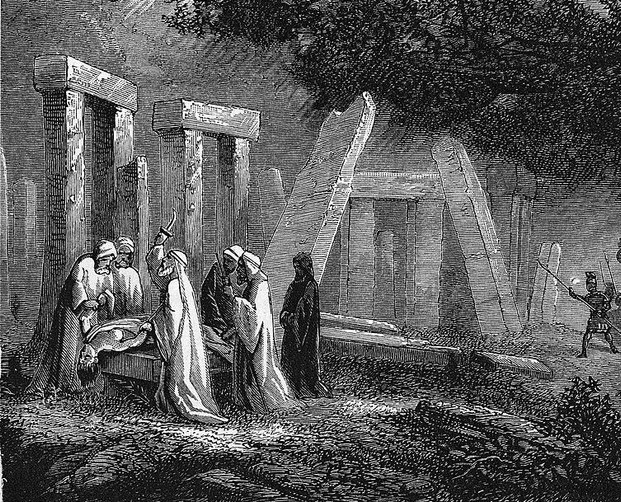
Basketry rite was a sacrificial rite that was described by Caesar, and it is also mentioned in the Strabo in more detail. The extreme punishment you can get in the British Iron Age was to be sacrificed to the Gods. When it was certain that someone was to be sacrificed to the Gods, everyone avoided them and did not talk to them or go near them. They were also stripped of any dignity and their rights were taken from them. They preferred to sacrifice criminals rather than innocent people to the Gods, but if no criminals were available then they also used innocent people as sacrifice (Caesar: De Bello Gallico 6:13:16 from Corpus Scriptorum Latinorum). Strabo also described the “basketry-rite” as it was mentioned by Caesar. He said that humans and animals were thrown together in a large figure made of straw and wood which was burning and it was an offering by burning them alive (Strabo IV 4:5 from Thayer).
If we look at ancient Rome, religious practices involved sacrifice and ritual, playing a crucial role in establishing a connection with the divine. These ceremonial acts were meticulously performed, and they had very strict traditional rules and norms that they had to follow. Each type of sacrifice that Romans took part in served a unique purpose. One prevalent form was the “piacular” sacrifice, which aimed to seek forgiveness from the gods for transgressions, whether intentional or unintentional. These rituals involved offering food, animals, and sometimes even humans. Another common type was the “votive” sacrifice, conducted to fulfill specific vows or requests made to the gods, with the belief that such acts of devotion would garner divine aid in achieving personal or communal goals (Versnel, 1993). It is evident that the concept of why these sacrifices were performed was common in Iron Age religions and Roman religions. Both did this to please the gods or have their mercy after some crime was committed.
British Iron Age gods were described by Caesar with Roman names and the purpose was to make them more familiar with the Roman people. He mentioned Mercury (inventor of all art) , Mars (god of war) Apollo (can divert disease), Jupiter (sovereign over the heavenly powers) (Caesar: De Bello Gallico 6:17:18 from Corpus Scriptorum Latinorum). According to Valerius Maximus Iron Age people also had belief in the Afterlife. Gallic cults were also mentioned by Lucan and he wrote that they were worshipers of many deities (Benvenuti 1991:40f). Most of the time Romans would identify the gods of this era with their own gods and replace them.
In Gaul and Germany, the Roman conquest brought significant changes to religious practices. While some elements of indigenous beliefs and rituals likely persisted, the imposition of Roman religious practices, such as the cult of Roman gods and the construction of temples, altered the religious landscape. Roman authorities often encouraged the integration of local deities into the Roman pantheon, a process known as interpretatio romana. With the exception of the Druids, the Roman attitude to religion in Britain was characterised by tolerance, and the invaders were receptive to influence. The Roman pantheon frequently incorporated deities from the cultures they had subjugated and made analogies between Celtic and Roman deities. As we discussed earlier, Julius Caesar associated the Roman deity Mercury with the Celtic god Lugus in his De Bello Gallico, because both were thought to bring light and enlightenment. Mother goddesses were revered in both native and Roman cultures as being able to affect fertility and protection. They were frequently portrayed in groups of three. In and around Roman Corinium (Cirencester), the Mothers, or the Matres, seem to be the most well-liked cult. Archaeological discoveries from locations in and around Cirencester, including Ashcroft, Watermoor Road, and Daglingworth, bear witness to a well-known local cult including a multitude of altars, reliefs, and Mothers’ representations (Lewis, 2019). These mother goddesses played a crucial part in the formation of religion in both the natives and the Romans.
Figure 2: Ashcroft Relief
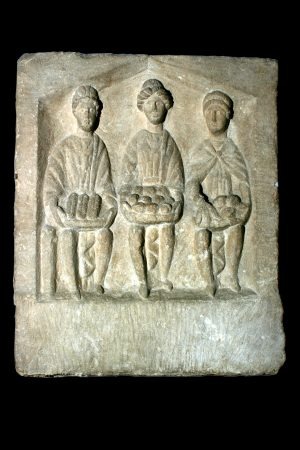
You can see three sitting goddesses carved from a local oolitic limestone and it dates back to the 2nd or 3rd Century AD. This relief was discovered at a site in Ashcroft in 1899. It was hypothesized that there was a temple made for these goddesses and it highlights how important Mother goddesses were to the inhabitants of Roman Corinium (Lewis, 2019).
Apart from the Mother goddesses there were three celtic figures that were turned Roman. These deities were adopted in the Roman religion and show an integration of the Iron Age religion into the Roman religion.
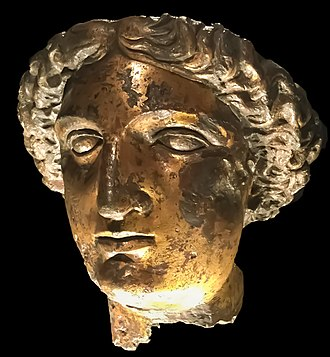
Bath’s thermal spring was the center of worship for Sulis, a deity in the localized Celtic polytheism practiced in Great Britain. The Romano-British worshipped her as Sulis Minerva; votive artefacts and lead tablets bearing inscriptions indicate that she was seen as a mother goddess who provided nourishment and life as well as a powerful conduit for the curses called by her devotees. She was also often associated with medicine, fertility and healing (Joyce & Terence, 1990).
Figure 3: Gilt bronze head from the cult statue of Sulis Minerva from the Temple at Bath, found in Stall Street in 1727 and now displayed at the Roman Baths
Cocidius was another deity in Romano-British religion which was also worshipped by the Iron Age religion in northern Britain. It was known to be the god of war and hunting so they equated him with Mars. They also equated Cocidius with Silvanus because of its power to grow forests and wild fields. For Britons and for low ranked Roman soldiers he was considered as a tribal god (Guirand, 1968). Both Cocidius and Silvanus had similar powers and were equated in both religions.
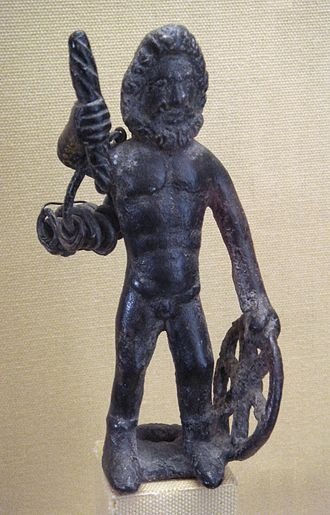
Taranis, a more ubiquitous Celtic character than the genii loci of hilltops and streams, is believed to have been a thunder god and is frequently seen with a wheel and hammer in Gaul. Because of this, some have drawn comparisons between Jupiter, the Roman sky god and god of thunder and lightning (Evans, 2022). He was worshipped primarily in Gaul, Hispania, Britain, and Ireland.
Figure 4: Taranis (Jupiter with wheel and thunderbolt), Le Chatelet, Gourzon, Haute-Marne, France
The similarities between these three deities show that there were gods who were worshipped both by Romans, and Iron Age people living in Gaul areas. Either they were different gods altogether and worshipped by both societies or they were the same god but Romans changed their name to adapt them to their own gods.
Both the Celts and the Romans believed in the afterlife, but their beliefs were somewhat different from each other. The Celts did not have a fear of death because in Celtic religion the afterlife was not scary and full of punishment and there was no disease, pain, and sorrow. The explanations of afterlife in Roman religion on the other hand is not very clear from the sources. Most people believed that the dead were alive in the Underworld. Greek culture has influenced and been adapted into Roman poetry, as shown in Virgil’s The Aeneid. The protagonist Aeneas explores an Underworld in this epic poem that is modelled after Hades in Greek mythology. Here, Aeneas comes across the dismal Tartarus, the home of the damned, and the dreamlike Fields of Elysium, where the souls of the happy dwell. On the banks of the River Styx, the unburied wait impatiently. Their spirits were thought to haunt the living.
However, this did not necessarily mean a wholesale adoption of Roman religious beliefs and practices. Instead, it often resulted in syncretism where local and Roman religious elements coexisted (Emmerson, 2022).
In Southern Gaul from the 6th to the 1st century B.C a particular type of ancestor or hero cult can be found. A lot of Cult places have been found and they are often described as ‘herôon’. There is still a lot of debate around what that means and there is controversy around the correct interpretation (Benoit, 1955). Within the ramparts of ‘oppida’ one can find a lot of cult places which indicate that urban society had a direct relationship with it. They typically include a common assortment of objects, such as têtescoupées, carved heads, pillars with niches for displaying heads or skulls, and oftentimes a portico and steles with horses. In Southern Gaul, these porticoes are typically the only examples of monumental (i.e., public and/or cultic) architecture. There was enormous investment of resources and manpower to make those porticoes compared to all the other artefacts of the cult which means that they had a significant importance in the cult.
In Britain, the situation was similar but with some unique characteristics. The Roman conquest of Britain led to the introduction of Roman gods and religious practices, alongside the maintenance of indigenous cults. Temples dedicated to Roman deities were constructed across the island, but evidence suggests that pre-existing Iron Age religious sites and practices persisted, sometimes alongside Roman ones. The Druids, for example, who held significant religious and social influence in pre-Roman Britain, were suppressed by the Roman authorities but likely left some imprint on the religious landscape.
The Germanic regions also had a similar impact on the Roman religion. Apart from adapting and assimilating military skills and trading terms from Roman military Scandinavians also adapted religion and ideologies of Romans and vice versa. Late Antiquity cults and Roman religion also had a strong influence on the Germanic peoples living close to the Limes. There were altars raised to praise different gods like Jupiter, Mars and Mercury in the middle of the Rhineland, but these altars were often raised by private individuals, not the state (Vermaseren 1956-1960, 47-143). It is also believed that where the Roman gods’ names appeared in the altars, those ones were raised by the Germanic people. In the Rhine areas the Germanic people were acquainted with the Mithraic mysteries (Davidson, 1978).
Hilda Ellis Davidson (1978) also hypothesize that Mithraic mysteries inspired the cult of Odin. She argued that the animals which surrounded Mithras for example the dog/wolf, the snake and raven were the same animals which Odin was surrounded with. Both Odin and Mithras were seen riding on horses and were armed. Romans associated both of these deities with Mercury. It shows how the religions of the Iron Age in Gaul areas influenced and got mixed with the religions of the Roman empire.
It is reported that the deities of Iron Age religions which were associated with other Roman religions served a main role in shaping the Roman civilization. The people both in private and public places showed respect for these gods. State also recognized most of the gods and they paid money and used resources to celebrate events related to these gods and decorate public buildings and other places with images of these gods (National Geographic Society, 2023).
Overall, while Roman religion and cult centers undoubtedly had a significant impact on the religious practices of Gaul/Germany and Britain, the extent to which they represented continuity with Iron Age religious practices varies depending on factors such as local resistance, cultural exchange, and the policies of Roman authorities. It is also important to note that even after the Roman Empire practiced Judaism and Christianity within the empire which were monolithic religions but still most of the empire was mainly a polytheistic society and people recognized and worshipped multiple gods and goddesses. The process was likely one of negotiation and adaptation, resulting in a complex interplay between indigenous and Roman religious elements in Gaul/Germany and Britain.
References
Arrowsmith, Aaron (1832). A Grammar of Ancient Geography,: Compiled for the Use of King’s College School. Hansard London 1832. p. 50. Retrieved 21 September 2014. gallia .
C. Julius Caesar. Caesar’s Gallic War. Translator. W. A. McDevitte. Translator. W. S. Bohn. 1st Edition. New York. Harper & Brothers. 1869. Harper’s New Classical Library.
Cf. Benoit 1955, 16-27; Arcelin and Brunaux (edd.) 2003 with Archelinand Gruat 2003 for Southern Gaul; Garcia 2004; Duval 1976, 21-22; Haeussler2007a. Also cf. Brunaux 2004, 118-124, chapter “Faire des héros”, esp. pp.118-122 for an interpretation of the sources on heroes and excarnation.
Davidson, H. Ellis. 1978. Mithras and Wodan. In J. Duch-esne-Guillemin (ed.) Études mithriaques. Acta du 2e Con- grès International Téhéran, du 1 er au 8 septembre 1975. ActaIranica 17. 99–110. Leiden: Brill.
de Vries, J. 1970 [1956–57]. Altgermanische Religions geschichte 1–2. Grundriss der germanische Philologie 12; 1–2. Berlin:de Gruyter.
Dillon, M., and Chadwick, N. (1967). The Celtic Realms, Weidenfeld and Nicholson, London.
Emmerson, A.L.C. (2022) ‘CHARLES W. KING, THE ANCIENT ROMAN AFTERLIFE:
DI MANES, BELIEF, AND THE CULT OF THE DEAD (Ashley and Peter Larkin series in Greek and Roman culture). Austin: University of Texas Press, 2020. Pp. xxix + 269. isbn 9781477320204. US$55.00.’, Journal of Roman Studies, 112, pp. 321–322. doi:10.1017/S0075435822000120.
Evans, E. (2022) Religion in Roman Britain: Spreading the word of the gods, HistoryExtra. Available at: https://www.historyextra.com/period/roman/religion-roman-britain-gods-pagan-deitie s/ (Accessed: 16 February 2024).
F. Guirand ed., New Larousse Encyclopedia of Mythology (London 1968) p. 237 Annaeus Lucanus. Pharsalia, Book I Archived 2006-05-02 at the Wayback Machine. Page 43.
Joy, Jody (October 2011). “The Iron Age”. In Insoll, Timothy (ed.). The Oxford Handbook of the Archaeology of Ritual and Religion. Oxford, United Kingdom: Oxford University Press. pp. 405–406. ISBN 9780199232444.
Joyce Reynolds and Terence Volk, “Review: Gifts, Curses, Cult and Society at Bath”, reviewing The Temple of Sulis Minerva at Bath: vol. 2 The Finds from the Sacred Spring, in Britannia 21 (1990:379-391).
Lewis, S. (2019) Mother goddesses, Corinium Museum. Available at: https://coriniummuseum.org/2019/08/mother-goddesses/ (Accessed: 16 February 2024).
National Geographic Society (2023) The gods and goddesses of ancient rome, Education. Available at: https://education.nationalgeographic.org/resource/gods-and-goddesses-ancient-rome (Accessed: 16 February 2024).
Ross, A. (1986). The Worm of the Spirit: Pagan Celtic Britain, Barnes & Noble, Totowa, N.J. Vermaseren, M. J. 1956–60. See CIMRM.
Versnel, H. S. (Ed.). (1993). “Faustus and the Roman Sacrificial Rituals: A Study in Social Anthropology.” Brill.